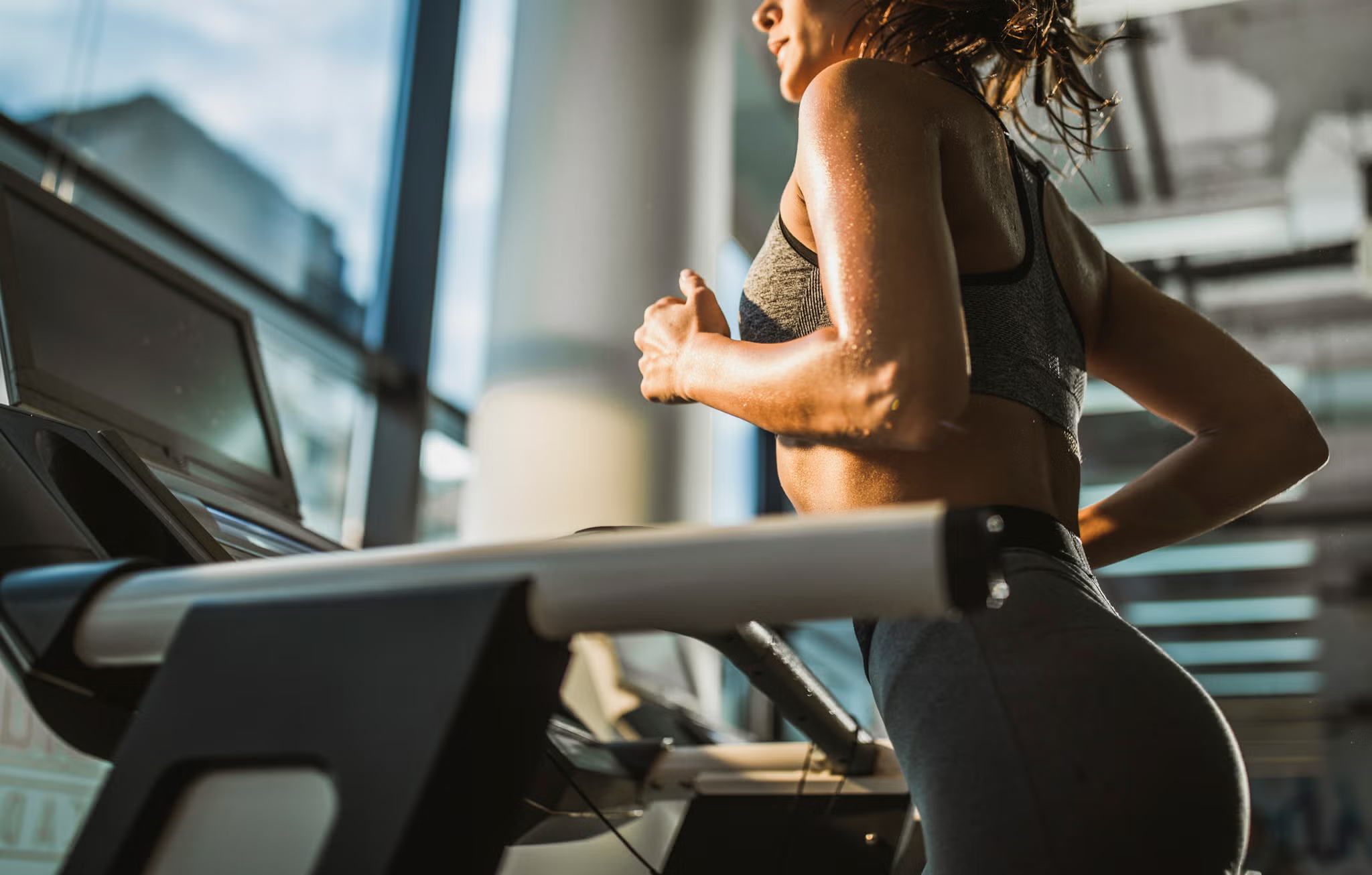
Running on a treadmill activates different muscles than running outside, which can make the workout feel harder even when it's biomechanically easier.
Amy Woods, a USAT-certified run coach and ISSA-certified strength and conditioning coach, explains that many runners shorten their stride on the treadmill and run more upright. Morgan Mowers, PT, DPT, a physical therapist and V.02-certified run coach, notes that most people position themselves too close to the front of the belt, further limiting their space.
This altered form changes muscle activation patterns. Mowers says runners see decreased activation of hamstrings and glutes, the larger muscles that propel you forward outdoors. Instead, the treadmill places more emphasis on hip flexors, quads, calves, and knees.
A treadmill's consistent surface also differs from outdoor running. Outside, terrain and incline vary with each step, requiring more stabilizing muscles in the ankles and calves. Mowers points out that on a treadmill, the surface stays identical. You also avoid environmental challenges like wind resistance and heat.
Despite these mechanical advantages, treadmill running often feels harder. Woods notes that running safely on a treadmill at higher speeds requires practice and more conscious awareness of foot placement, arm swing, and eye focus. Mowers adds that the consistency of pace on a treadmill can make effort feel harder. Outdoors, you may naturally shift from an 11:00 pace to a 10:30 pace across a mile without noticing, but on a treadmill you stay locked at one speed unless you manually change it.
Rachelle Reed, PhD, an exercise physiologist, points to mental factors. Outside, natural variations in scenery, incline, terrain, and pace keep your brain engaged. A 2019 meta-analysis found that at faster speeds, runners rated their effort as harder on a treadmill compared to outdoors.
If you're training for a race, outdoor running is superior because race day will require your muscles to handle outdoor terrain, wind, and environmental factors. However, Mowers recommends staying inside when ground conditions are icy or snowy, temperatures exceed 85 degrees, serious weather threatens, or air quality is poor (index over 101).
Woods suggests not fixating on pace during treadmill runs. Instead, focus on time and rate of perceived exertion to match your intended effort level, even if the pace looks slower than outdoors.