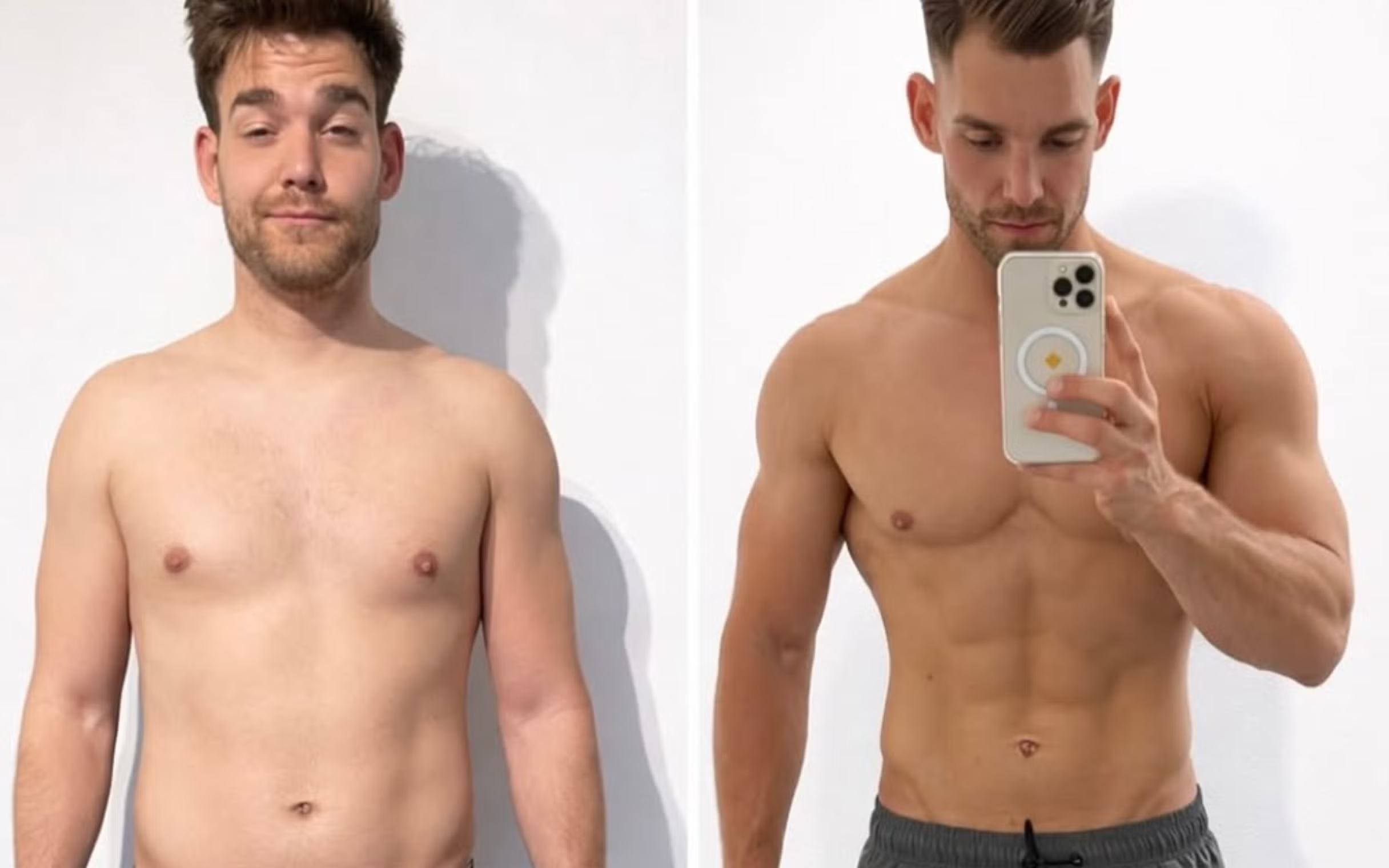
Strength coach Gareth Sapstead helped business owner Mark Schadenberg achieve body recomposition over 11 weeks, losing fat and gaining visible muscle while dropping only 4 pounds before a Men's Health Netherlands photoshoot.
Sapstead challenges the conventional advice to "bulk first, cut later." He explains that fat tissue and muscle tissue operate through different metabolic pathways, allowing simultaneous fat loss and muscle gain when conditions for muscle protein synthesis are met: sufficient protein intake and challenging resistance training.
Sapstead references research showing the phenomenon across multiple studies, including trials where participants consumed 400 to 800 additional daily calories from protein. Those extra calories did not cause weight gain. Instead, participants either maintained weight or lost fat while gaining or preserving muscle.
Schadenberg began with several factors working against him. His training had lapsed, his sleep was poor, his diet lacked structure, and he was chronically undereating protein. Sapstead describes each of these as a "recomposition accelerant" when corrected. Returning to resistance training after a long break produces responses closer to those in beginners, with fast adaptations and quick muscle recovery.
After 11 weeks, Schadenberg was 4 pounds lighter but showed considerably more muscle and significantly less body fat in photographs.
Sapstead says recomposition works best for people returning to consistent strength training, carrying excess body fat, habitually eating too little protein, or with poor sleep and recovery. For experienced lifters who have trained intelligently for years, progress is likely slower.
For returning lifters, Sapstead recommends eating at or slightly above maintenance calories, with 200 to 300 additional calories from protein. He sets protein at approximately one gram per pound of bodyweight as a starting point. Perform three to four structured resistance-training sessions weekly with progressive overload, gradually adding weight, reps, range of motion, or work quality.
Sapstead warns that stable bodyweight during recomposition does not signal failure. He recommends tracking progress through photographs every two to three weeks, gym performance, and how clothes fit rather than relying on the scale.